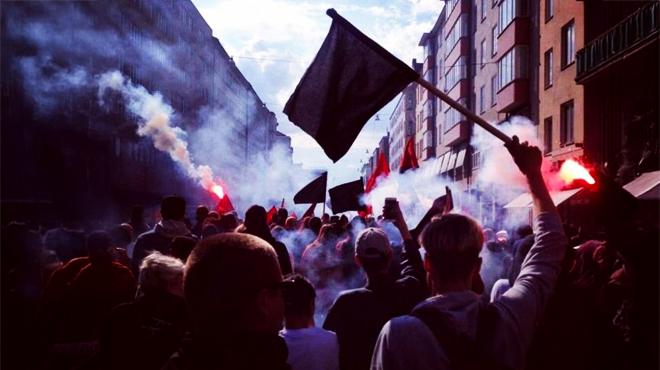
May Day is not a holiday in the usual sense. It is not a symbolic tradition or a nostalgic memory from a bygone labor movement. May Day is the working class’ day of struggle – a day which grew out of strikes, repression, and bloody conflicts between labor and capital.
When workers at the end of the 1800s organized for an eight-hour workday they were not met with understanding. They were met with police, military and employer violence. But they were also met with something else: a growing solidarity. Workers began to realize that they shared the same interests, regardless of profession, language, or nationality.
It is from this insight that the labor movement was born.
The strength of the working class has never been in wealth or political privilege. It has been in organizing. In labor unions, in political movements, in collective struggles at places of work and in society. When workers organize they can change society.
And exactly that is why the working class organizing has always met resistance.
Throughout history economic and political elites have used various methods to break the power of the working class. Sometimes through laws that limit the right to strike. Sometimes through economic pressure. And sometimes through something even more brutal: fascism.
Fascism did not form in a vacuum. It formed in times of crisis, when social conflicts intensified and the labor movement challenged economic power. In these situations fascism functioned as a counter-revolutionary force.
When Mussolini’s Blackshirts marched through Italy their first target was not minorities or cultural institutions. Their first target was the labor movement. Labor union halls were burned, strikes were crushed and socialist organizations were attacked.
When the Nazis took power in Germany in 1933 one of their first acts was to dissolve all free labor unions. Their assets were seized, their leaders imprisoned and the workers’ collective organizing was replaced with State-controlled structures.
In Spain fascism attempted to crush a republic where workers and peasants had begun to take power over their own lives. The international solidarity – where thousands of volunteers traveled to fight against fascism – shows that the labor movement already then understood what was at stake.
History is clear: fascism has always been the enemy of the labor movement.
Fascism is built on division. It attempts to convince workers that their real enemies are not economic power structures but other people – people with different backgrounds, different languages or different religions. It replaces solidarity with suspicion and collective struggle with nationalism.
It is no coincidence. A divided working class is a weak working class.
When people begin to see each other as competitors instead of comrades the possibility of challenging the structures that create inequality and exploitation also vanishes. Fascism therefore does not offer a solution to the problems of the working class – it functions as a protection for the power relations which create those.
Therefore antifascism is not just a moral stance. It is a political necessity.
To be an antifascist means to defend the working class’ right to organize itself. It means defending the right to strike, freedom of association and the democratic rights which make collective struggle possible. It also means actively countering the ideologies that attempt to divide the working class.
But antifascism is more than defense. It is also about the future.
It is about building a society where economic power is not concentrated in the hands of a few but is shared by the people who actually create society’s wealth. A society where labor is valued higher than profit and where solidarity is stronger than competition.
May Day reminds us that this is not a utopia. The rights we today take for granted today – the eight-hour workday, vacation, social security – were once seen as impossible. They became a reality because people organized and fought for them.
But history also shows that these rights are never permanent. They can be eroded, dismantled and taken back if the working class loses its collective strength.
Therefore May Day is still a necessity.
It reminds us that the struggle of the working class is not over. It reminds us that solidarity is stronger than division. And it reminds us that antifascism is not a separate issue aside of the class struggle.
Antifascism is the working class’ self-defense.
When we defend solidarity, we also defend the possibility of changing society. When we stand up against fascism we defend the working class’ right to organize itself and fight for a better life.
And that fight continues.
For solidarity.
For organizing.
For the liberation of the working class.
/Antifascist Action Stockholm
May 1, 2026
Translated by b9AcE to the best of my ability, from the original text in Swedish. Any errors are to be presumed mine, not antifa/AFA’s.